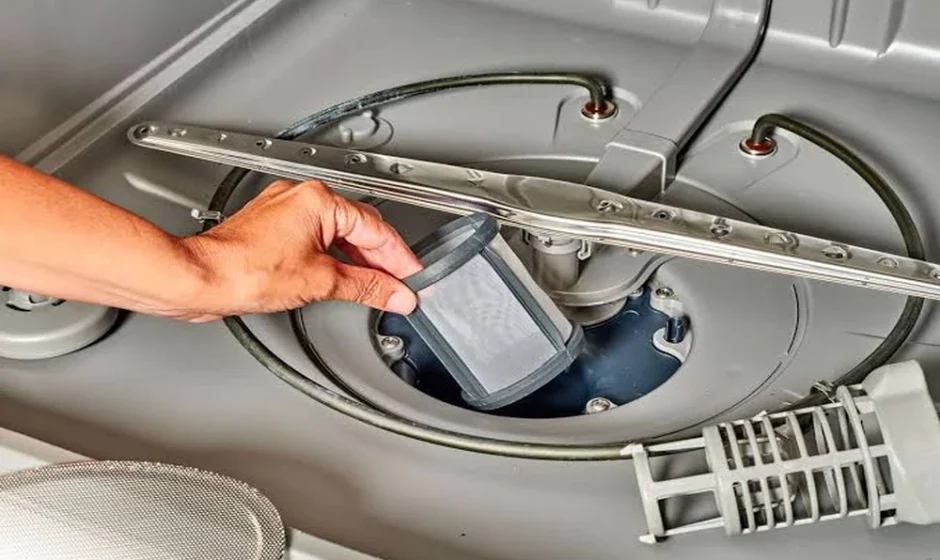

Water standing in the bottom of a dishwasher at the end of a cycle is one of the most frequently reported appliance faults and one of the most frequently resolved without any parts. In the large majority of cases the pump is fine and something is in the way.
This guide works through the drainage path in order, from the easiest check to the hardest.
Drainage-related codes mean different things across model ranges, and the Miele dishwasher manuals set out the mapping per appliance.
Understand the path first
Water leaves a dishwasher by a fixed route: through the filter assembly in the tub floor, into the sump, through the drain pump, along the drain hose, and into a waste connection – usually a sink trap spigot or a standpipe. A blockage anywhere along that route produces the same symptom.
Check them in that order, because the first two account for most cases and take minutes.
1. The filter assembly
Twist out the cylindrical filter in the tub floor and lift out the flat mesh beneath it. What you find there is usually the answer: food debris, a fragment of glass, a fruit sticker, a bone chip.
Rinse both parts under a running tap, using a soft brush on the mesh.
Check the fine mesh against the light – it clogs invisibly with grease and starch.
Reassemble properly and confirm the filter locks in position. A filter left loose lets debris straight into the pump, which converts a five-minute job into a service call.
Manufacturers expect this to be cleaned regularly. Most owners have never done it.
2. The sump and pump impeller
With the filter removed, sponge out the standing water and look into the sump. Check for debris around the impeller area. Broken glass is common and warrants care.
Some models have an accessible pump cover; others do not. Do not force anything, and disconnect the appliance from the mains before putting a hand into the sump.
3. The drain hose
Check for kinks behind the appliance. A hose crushed against the wall when the machine was pushed back is extremely common.
Check the hose is looped up to the required height before descending to the waste connection. Without that loop, the machine either siphons continuously or fails to drain, depending on the installation.
Disconnect the hose at the waste end into a bucket and check for a blockage at the connection point, which is the narrowest part of the path.
4. The waste connection
If the appliance drains into a sink trap spigot, two specific problems recur.
First, on a newly installed machine, the blanking plug inside the spigot may never have been knocked out. This produces a machine that has never drained since installation, and it is a surprisingly frequent finding.
Second, the sink trap itself blocks with grease and food, particularly if a waste disposal unit shares the connection. Test by filling the sink and watching it drain – a slow sink means a shared blockage, not a dishwasher fault.
5. The air gap, where fitted
Installations with an air gap fitting on the worktop can block at that fitting. Unscrew the cover and check for debris. It is small, easily overlooked, and a classic cause.
Distinguishing a blockage from a pump fault
Listen during the drain phase with the appliance running. A pump that hums or runs with no water movement suggests an obstruction or a seized impeller. Complete silence during the drain phase suggests the pump is not being driven, which points to an electrical or control fault.
Also check whether the appliance has displayed a drainage-related error code. Codes narrow the fault area considerably, and the meanings are model-specific, so confirm the code against documentation for your exact model rather than a generic list.
Filter assemblies and pump access panels differ between machines, which is worth confirming in an archive of service manuals before removing anything.
Preventing it happening again
Scrape plates before loading. Rinsing is unnecessary; scraping is not.
Clean the filter monthly, or more often with heavy use.
Run a hot maintenance cycle with a dishwasher cleaner periodically to clear grease from the sump and hose.
Check behind the machine for a kinked hose after any move.
Do not overload – water needs to circulate to carry debris to the filter.
Frequently asked questions
Is standing water always a fault?
A small amount of water in the sump is normal on many models – it keeps seals from drying out. Several centimetres covering the tub floor is not.
Can I use drain cleaner?
No. Caustic products damage seals and internal components and can be dangerous in an enclosed appliance. Clear blockages mechanically.
Why did it start suddenly?
Blockages build gradually and then cross a threshold. A machine that drained fine last week was probably already partly restricted.
Note: disconnect the appliance from the mains and turn off the water supply before removing filters or hoses. Broken glass in the sump is common – use care. Error code meanings differ by model.